
The NEO Case:
Dividend chains under scrutiny
Corporate income tax
In NEO Group (C-203/25, 15 October 2026), the Court of Justice of the European Union (CJEU) allows Member States to refuse the withholding tax exemption under the Parent-Subsidiary Directive even where the EU parent company is genuine and is the beneficial owner of the dividends, if the distribution is part of a non-genuine arrangement further up the chain. The judgment is in line with Belgian case law and directly concerns Belgian companies distributing dividends to EU parent companies.
pour une version imprimable/pdf: disponible ici
A retenir:
- Substance is not a safe harbour: the genuine activity of the EU parent company and its status as beneficial owner (even under a tax treaty) do not, in themselves, exclude abuse.
- The entire chain is relevant: transactions in other Member States, between non-residents and after the distribution, as well as the tax advantage obtained by the ultimate beneficial owner (UBO), may be taken into account.
- Indicators, not presumptions: matching amounts and onward transfers, immediate or spread over time, point to abuse but do not establish it. The burden of proof lies with the tax authorities.
- The knowledge of the distributing company is irrelevant: the abusive purpose of one entity in the chain, or of the UBO, suffices. The distributing company nevertheless bears the withholding tax.
To do:
- Map where the dividends paid by your Belgian companies to EU parent companies end up: onward distributions, loans, set-offs and debt repayments, up to the UBO.
- Identify restructurings above the EU parent company: newly interposed holding companies, share sales on deferred price or vendor loan, assignment of receivables to the shareholder.
- Document the business reasons and the decision-making process at each level of the chain, including the UBO.
- Before each distribution under the exemption, review the chain and consider contractual protection (representations and indemnity) from the parent company or the UBO.
- Belgian holding companies receiving dividends from EU subsidiaries: expect the State of the subsidiary to look at what happens to those dividends after Belgium.
Our team is available to review your dividend flows and to document your position.
1. THE FACTS
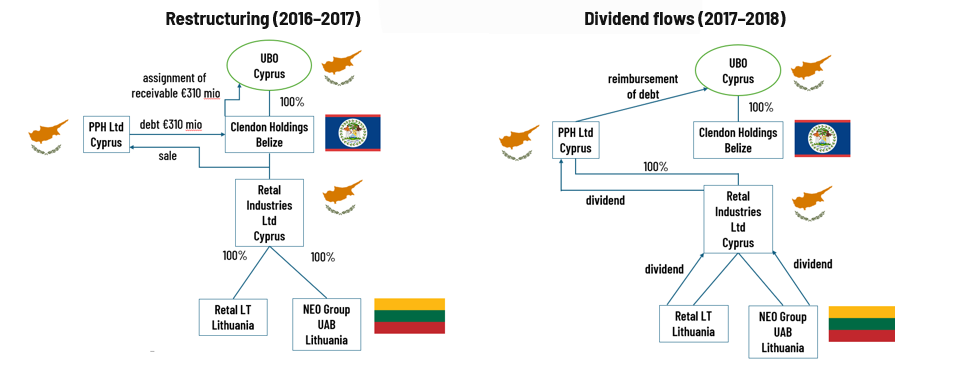
NEO Group UAB, a Lithuanian company, distributed EUR 15 million in dividends in 2016 and 2017 to its sole shareholder, Retal Industries Ltd (Cyprus), under the withholding tax exemption. The Lithuanian tax authorities did not dispute that Retal Industries carried on a genuine economic activity and was the beneficial owner of the dividends. They challenged the structure above it:
- PPH, a Cypriot company incorporated at the end of 2016 and without employees, acquired the shares in Retal Industries from Clendon Holdings (Belize) in early 2017 for EUR 310.4 million; the price remained unpaid;
- Clendon assigned its receivable to the individual who owned both Clendon and PPH (the UBO);
- in 2017 and 2018, Retal Industries distributed EUR 28.9 million to PPH, which transferred the same amount to the UBO by way of loans and assignments of receivables, set off against the unpaid purchase price. PPH itself distributed no dividends.
The Lithuanian profits thus reached the UBO without being taxed as dividends. The Lithuanian tax authorities refused the exemption and levied the 15% Lithuanian withholding tax on NEO Group.
2. THE JUDGMENT
2.1 A genuine parent company is not enough
The anti-abuse rule of Article 1(2) of the Directive is not limited to conduit companies. Neither the genuine economic activity of the parent company nor its status as beneficial owner, including under a tax treaty, excludes abuse by itself: the tax authorities must assess the arrangement as a whole.
2.2 The whole chain, across borders and over time
The analysis may cover transactions carried out in other Member States, between non-residents and after the distribution, as well as a tax advantage obtained by another person in the chain, including the UBO. The Court builds on its Nordcurrent judgment (C-228/24).
2.3 Indicators, not presumptions
Matching amounts, onward transfers and their timing are relevant indicators. The transfers need not follow shortly after receipt: recurring transfers over a longer period may also be relevant. These elements cannot create a presumption of abuse: the tax authorities must establish its objective and subjective elements in the light of all the circumstances.
2.4 Knowledge of the distributing company
The tax authorities do not need to prove that the distributing subsidiary knew, or should have known, of the arrangement. The subjective element may be established in respect of any entity in the chain or the UBO.
3. BELGIAN PERSPECTIVE
Belgian law contains the same anti-abuse rule. The withholding tax exemption on dividends paid to an EU parent company (art. 106, para. 6, RD/ITC 92) is refused where the dividend is linked to a non-genuine arrangement put in place with the main purpose, or one of the main purposes, of obtaining the exemption (Article 266, in fine, ITC 92). A similar rule applies to the dividends-received deduction (Article 203, para. 1, 7°, ITC 92).
The Court of Cassation already ruled on 30 November 2023 that all transactions of the group must be assessed, and that a valid commercial reason for an intermediate holding company does not, in itself, exclude abuse of the overall series of transactions. NEO Group confirms this approach at EU level.
The risk lies with the Belgian distributing company: as withholding agent, it owes the withholding tax and late-payment interest, even if it was unaware of what happened upstream. For withholding tax returns applying an exemption under an EU directive, the investigation period is 4 years (see here our 2026 newsletter about this topic).
The judgment does not call holding structures into question as such. According to the Advocate General, abuse remains exceptional, and a parent company with a genuine function that freely disposes of the dividends is in principle protected. The Court did not expressly address the AG’s distinction between abuse of the Directive and abuse of the UBO’s state’s national law. That question remains open.
This document is of a general nature, for information purposes, and does not constitute custom made personal advice. Although carefully drafted, it should not be relied upon as legal advice and as such does not engage any liability of the law firm Advisius .
© Advisius (CBE 0741.762.760)